Willunga Basin
PHOTOGRAPHY
Willunga Basin History

Introduction
On face value, the Willunga Basin is a beautiful mix of beaches and wineries which dominate the scenery. The reality of the region goes far beyond with a rich pioneering history that links back to the start of colonisation of South Australia.
When I started my own research I was focused on a few local identities which led to way more questions than answers.
Answers that quite frankly startled me and leaves me wondering why most of our own state history isn't taught in schools.
Read on and make up your own mind.
My story starts with a guy named Gabrielle Cox who built a cottage in Aldinga 1842 and donated land for the local church and cemetary to exist. Nice of him to do so but it got me thinking...how much land did he own and how did he come to own the land?
This is not that simple to answer and here's why?
Colonisation began only 6 years before this cottage was built.
It was 1836 when colonisation was officially declared in Glenelg, a beachside suburb in Adelaide, 43km from Aldinga. If there were roads, they would have been dirt tracks at best. Documentation was scarce, these people were busy building a life, laying foundations for their own family and everyone else's future. It was the deal they signed up for and the deal they delivered on after moving to the new colony from England.
A document that caught my attention was the Hundred of Willunga. The first official surveyed map outlining land for sale and led me to the most important business name in South Australia's short history. The South Australian Company. Formed in 1835 in London as a direct result of the announcement of a new colony and subsequent failing attempt at colonisation of South Australia in 1834. Yes, failing attempt. To understand this, we have to go back to when the first seeds of South Australia becoming an official British Colony were being sowed. That first seed was a series of proposals published from 1929, written by Edward Wakefield and called "A letter from Sydney".

A Letter from Sydney
circa 1829
Edward Wakefield
Edward Wakefield was an English politician who played key roles in colonising Australia, New zealand and Canada. After seeing serious economic and population issues in England, he theorised
on the systematic colonisation of South Australia to act as a pressure valve for Britain.
Two big problems though.
1: he had never set foot in Australia
2: he was arrested and spent time in gaol.
You see, while still in England, he was arrested, charged and found guilty of abducting a 15yr old girl, spending 1827-1830 in gaol. It was in gaol, with time on his hands, he focussed on his theories which later were to be known as the Wakefield Scheme. During this time in gaol he wrote a series of anonomous publications as if he was a settler living in Sydney, Australia. These publications were made available to the public as well as policy makers. To add authenticity and believability they were edited by Robert Gouger to hide the name Edward Wakefield.
The publications are now famously and simply reffered to as,
A Letter from Sydney.
The published proposals were about a systematic colonisation solving Britain's labour and economic problems through a selection criterior which included laborers, tradespeople, artisans and capitol.
Together with his brother Daniel (also in gaol!), drafted legislation to start the colonisation process.
"An Act to empower His Majesty to erect South Australia into a province or provinces and to provide for the colonisation and government thereof"
August 15, 1834 the bill was passed by the British Parliament as
"The South Australian Act"
George Angus
In this act, a target of £35000 was to be collected in land sales before the British Government would agree to start colonising South Australia. The proceeds were to fund future travel of immigrants from England.
Selling at one pound per acre, land sales faultered putting the colonisation in serious jeapordy. Enter George Fyfe Angus.
In 1835, the South Australian Company was formed by George Angus, Henry Kingscote and Thomas Smith. They agreed to buy up the unsold land to make sure the £35000 target was reached but it was at the reduced price of 12 shillings per acre.
The South Australian Company was to develop essential infrastructure critical to the new colony.
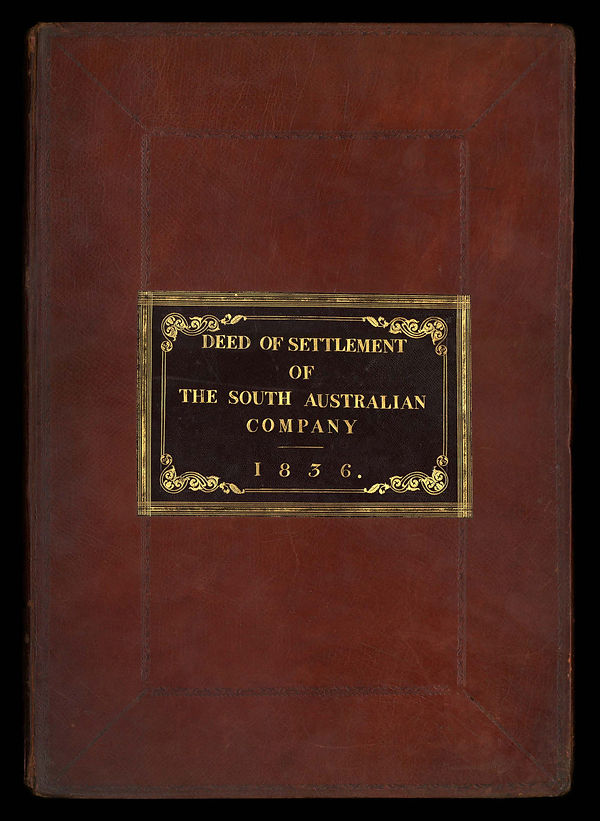
So in 1836, possibly the most significant document in South Australia's history was drawn up and put into effect:
Deed of Settlement of The South Australian Company
The South Australian Company was now the official financial backer of the colonisation plan.
South Australian Company
1834 Forging ahead
The South Australian Company was a commercial enterprise not related to the British Government or the newly established Colonisation Commission.
Prior to the South Australian Act of 1834, a lobby group called the South Australian Association had formed in England, pushing for colonisation in South Australia. They wanted the new colony to be independant, more or less, but the British Government thought otherwise and a Governor was to be established representing the Crown if it was to go ahead. This lobby group included Edward Wakefield, Robert Gouger, Robert Torrens Snr and George Angus amongst other men from various backgrounds.
They lobbied successfully but administration of the colony was to be shared by a Governor representing the Crown and a Colonisation Commission based in London with a represenative in the colony.
Once the South Australian Act was passed, George Angus resigned from the association and put in a proposal to start a new company called the South Australian Company to buy up unsold land. The Colonisation Commision agreed as long as the company didn't set up a monopoly. With Angus as the chairman, Samuel Stephens as the first manager, the board included the names Raikes Currie, Charles Hindley MP, Henry Kingscote, John Pirie, John Rundle and Henry Waymouth. Anyone who has been to the City of Adelaide or lives here knows these are very familiar street names in the city. The directors were each required to invest at least £2500 in the company. The biggest purchases of land were by Angus and Currie in the name of Company. It was given the responsibility to fund essential infrastructure projects like roads, bridges, wharves etc, all of which the British Government didn't want to be burdened with.
Another question I asked myself was, what businesses did the intial investors have that made them so wealthy they could afford to colonise a new country?
Here's the twist...a free colony paid for by unfree labour?!
By all accounts, many of the initial directors had ties to chattel slave labour and this was used to build wealth until 1833, when slavery was banned by the British Government. Compensation was handed to slave owners for their "losses". To pay for this compensation, the British government borrowed money to the value of 40% of the Treasuries annual budget! It was money borrowed to it by financiers including Nathan Rothschild. Using public money, the government took 180 years, 1833- 2015, to finished paying the debt. Only a decade ago!
On 30th June 1834, an historic meeting took place in Exeter Hall , the Strand, London. All the objectives and plans were presented to the public after which hundreds of enquiries from prospective emigrants were recieved.
I'll join the dots...1833 slavery was abolished, slave owners granted huge compensation payouts using borrowed money...1834 South Australian colonisation approved...1835 South Australian Company, started by former slave traders, formed to buy land and build infrastructure in the new colony. British tax payers finished paying off the debt in 2015.
With money guaranteed and British citizens looking for a new start in life,colonisation was underway by two different entities. The British Government handled by the South Australian Commission, and the South Australian Company headed by George Angus.
January 1836, the South Australian Company was first to set sail for Kangaroo Island, ahead of the Commission's first fleet. Upon arrival at Kingscote in July they set up South Australia's first free settlement. Unfortunately farming was deemed unviable and the decision was made to shift to the mainland.
Over the next 6 months a total of nine ships arrived in South Australia. The British Government's Surveyor General, Colonel William Light, arrived in August to survey land and make a decision on where the City of Adelaide would be built, before the arrival of Captain John Hindmarsh aboard the HMS Buffalo, December 1836 .
Colonel Light started surveying the land and over the next 130 years, South Australian land was divided into units called Hundreds. There were 540 Hundreds published across the State.
As these were produced, the South Australian Company continued purchasing sections and providing money for the infrastructure for continued growth.
The Hundred I'm focussing on is the Hundred of Willunga, circa 1839. As a footnote, the South Australian Company continued on until it was liquidated in 1949 and absorbed into what is now Elders Limited. Another company that has 19th century roots. It's head office was Gawler Chambers on the corner of North Terrace and Gawler place, which has recently been bought by the Shahin Family of the On the Run fame. A family that moved to Australia from Lebanon and started with one service station on David Terrace, Woodville Park then turned it into a business which sold for over a billion dollars. That is a story for another day but it's great to see a South Australian success story re-investing in our state!


Hundred of Willunga
1839-1850 A Wild Frontier
Once Adelaide was surely progressing, the need to aquire farming land commenced. Under the direction of Colonel William Light, John Mclaren was sent to survey the Willunga area in what turned out to be the Hundred of Willunga. Some of the parcels of land were bought by the South Australian Company. This would enable early settlers to either buy or lease land off of either the Government or the South Australian Company in accordance with the Wakefield Scheme.
After surveying was complete the first land was offered to farmers in October 1939, followed by Willunga township allotments in December. The first official local governance was by the Willunga Road Board from 1850-1853. The area covered was Willunga, Aldinga, Mclaren Vale, Noarlunga, Lower Meadows and parts of Myponga.
But this leaves about 10 years from first land surveyance to local governance. During this time there were a group of men that literally broke new ground. They did this through either buying or leasing sections of the Willunga Basin or gaining occupation licenses which allowed them to use unsold land until a buyer was found. By 1850, certain men stood out and were given the title of "Influential men of the South".

"Influential Men of the South"


Laying Foundations
In 1839 John Mclaren surveyed the area that was now know as the Hundred of Willunga. The first local committee of any description was the Roads Board in 1850. Roughly ten years that shaped the future of the area and forged a reputation of quality goods production which provided employment and excitment for a bright future.
Edward Loud's discovery of first class slate in Willunga provided a strong building material which was used extensively around Willunga. Samuel White's flour mill was so succesful they named a suburb after him...Whites Valley. William Colton and Charles Hewett bought sections 136 and 147 and called it Daringa Valley, later to be renamed Mclaren Vale. Colton's son grew up to be the South Australian Premier John Colton, 1876-1877 and received a Knighthood. Abraham Pethick was one of the first 5 farmers to send wheat back to England. Gabrielle Cox donated land for the Methodist Church and cemetary in Aldinga. Joseph Butterworth built his own flour mill in Whites Valley. John Pengilly and George Lovelock are great examples of many pioneers of the time. Both arriving in the early 1840's but not owning land until at least 1845. Despite this lack of land ownership, by 1851 both were regarded as "Influential men of the South" by clearly earning respect amongst fellow early settlers. In a time and place where no local government existed, it speaks volumes for the pioneering spirit if the era.
Footnote: The nine settlers mentioned here had a total of 61 children between them. I'd suggest foundations weren't the only thing they were laying down! They were serious about population growth and lets not forget to mention the women having all those kids! That's as tough as it gets.

Law and Order
Governance Arrives
It was mentioned earlier that there was no council in the area until the mid 1850's, however there was a police presence in the form of mounted Police. While John Mclaren was surveying the Hundred of Willunga, Government land was set aside as a depot for surveyors and Police. Three huts in fact were built. One for the Police, one for surverors and one to act as a Post Office. The Police actually doubled as a postal service as well. John Pollard was one such Police Officer. He arrived in 1836 and was a foundation member of the mounted Police force until 1843.
It wasn't until 1850 when the Willunga Road Board was first introduced to develop local infrastructure such as roads and culverts. In 1852 The Districts Council act was introduced which paved the way for the proclomation of the District Council of Willunga on 18th August 1853.
In 1855 a new police station and courthouse was built and initially used as an immigration depot for up to 40 female Irish immigrants who were involved in the major shipwreck of the Nashwauk off the coast of what is now Moana. They would stay there and hopefully gain work in the future.
1856 was the year a new building came into use for the purpose it was built. Police now had holding cells and a magistrate would visit once a month to decide on anything from drunkenness to murder which is an indication that there were some wild times and strong personalities fighting for either power or survival on land that was still being developed.
Aldinga seperated from Willunga in 1857 with John Norman as the chairman, Samuel White, Joseph Butterworth and P.Ward as councellors but was reunited with Willunga in 1932.


Building Heritage

Candle in the Window
I heard something recently that suggested that you don't die until your name is spoken for the last time. I believe it's important that the past is remembered for all it's good and bad. We live and hopefully learn as time goes on. There is a dark side to our history here but it's not something we admire or applaud. The pioneers that made their way to South Australia were good, hard working people that paid their way for an opportunity of their family having a better life. George Lovelock at 37 years of age travelled 4 months on a boat, had 13 kids, declared an influential man of the south, died at 51 years of age after toiling away on untapped land. He was the first recorded burial in the Aldinga church cemetary. Efforts like his should never be forgotten, I personally will be forever greatful.
To prove how young a nation we are, a guy named George Sara arrived in 1849, died in 1914. Well, my Father arrived in the 1950's from Italy where the colosseum was built 2000 years ago. We are so young as a nation and are still working ourselves out.
Remember these names. John Fidge, his son Lewis Fidge, Thomas Martin, James Mcaffery, Thomas Kell, Henry Malpas, Francis Culley and John Norman.
John Norman. So great they named a town after him. Normanville.
You get to Normanville on a road cut over the Sellick Hill which was conquered by a team led by the man himself.
They said it couldn't be done.
Norman stood at the Sellicks Hill hotel and said "hold my beer".
As a result of conquering the impossible, they renamed the hotel after him to Norman Victory hotel. Now known as the legendary Victory Hotel.
Great venue, great story, great man.
Footnote: Colonel Light died the year the Hundred of Willunga was being surveyed. John Norman was the undertaker of his funeral at Light Square in the city of Adelaide. Colonel Light is still the only person buried within the city limits.


Famine to Fame
Cometh the Hour, Cometh the Man
In 1851 the Aldinga farmers association was created to support, promote and display what the area had to offer. Out of this came a tradition of ploughing competitions. These competitions showcased the achievements of local blacksmiths, horse and oxen breeders and owners, and the ploughmen. Competitors ploughed an area within a set time and were judged on the straightness, depth and evenness of their furrows. So successful were the farmers in 1853 the first Willunga jetty was built to accomodate the extensive export markets. By the 1860's Port Willunga was the second largest port in the colony.
1865 saw the Aldinga, Willunga and Mclaren Vale farmers associations amalgamated to host the Willunga Show. This eventually was cancelled in 1968 but has been replaced with the annual Almond Blossom Festival and weekly Willunga Farmers market, which is a must do for anybody visiting.
An upgraded Willunga jetty was given the approval of local councils based on the growth of the area.
But there was trouble ahead in the form of drought and over farming of land. Many faced bankruptcy or at least financial hardship which would have been a bitter pill to swallow after all they had been through. Samuel White, could have been the biggest fall of all, filing for bankruptcy. It was a disasterous time for the settlers and a bleak outlook for the future of the colony.
Cometh the hour, cometh the man.
The hour: 1938. The man: John Reynell.
It wasn't the hour exactly but Reynell planted some vines when he first arrived in the colony so he had roughly 20 years experience on how to care for the vines annually. But this was in the suburb we now call Reynella, not the Willunga Basin. Regardless, he is still regarded as the Godfather of the wine region and will always be saluted a such.
But who planted the first vines in the Willunga Basin?
That honour lies with George Manning who purchased an appropriately named "Hope Farm". Purchasing the property in 1850, his first plantings were in 1851 and built his first winery in 1855 in what undoubtably would have become the inspirational saviour of the region.
The Basin required a shift away from wheat and cattle grazing and fortunately has a mediterranean type climate. Perfect for grape growing. It was adopted on scale and by the 1870's grapes were well on their way to being the number one industry in the Willunga Basin. By 1890, Thomas Hardy and sons Tintara winery was the biggest business in the area and the Mclaren Vale region has become one of the best wine regions in the world.
Over the years, the region has built on the 19th century efforts and gone on to earn the reputation of being a quality holiday destination with a magical blend of modern viticulture and old world charm.
Which leads me back to Gabrielle Cox and a small white cottage on Old Coach road Aldinga, affectionately known as Cox Cottage.
Blink and you'll miss it. The Birth of a colony hidden in plain sight.
The cottage is nestled amongst trees just off the road behind a white picket fence. It was part of Gabrielle's property called Hackle Farm and resides on what was section 400 of the Hundred of Willunga. Section 400 was one of ten land titles Gabrielle and his wife Louise owned or leased but was potentially the most significant because it covered all of the new Aldinga township, which enabled the Cox's to gift the community the land to build a church and cemetary. Both were, like many others, fantastic contributor's to the new colony.


Final Thoughts
I'll leave the final words to a man that was referred to as the "grand old man of Willunga" George Sara, who arrived in 1848 and died in 1914 at the age of 100yrs and eight weeks.
George summed up his life as follows:
‘South Australia has made marvellous progress since my arrival here. There have been good times and bad ones, and I have had my ups and downs: but I have been blessed with a buoyant optimistic spirit,
and my life in this beautiful garden of God’s earth has been a happy one’.
Amen.